
By- Simon Creed
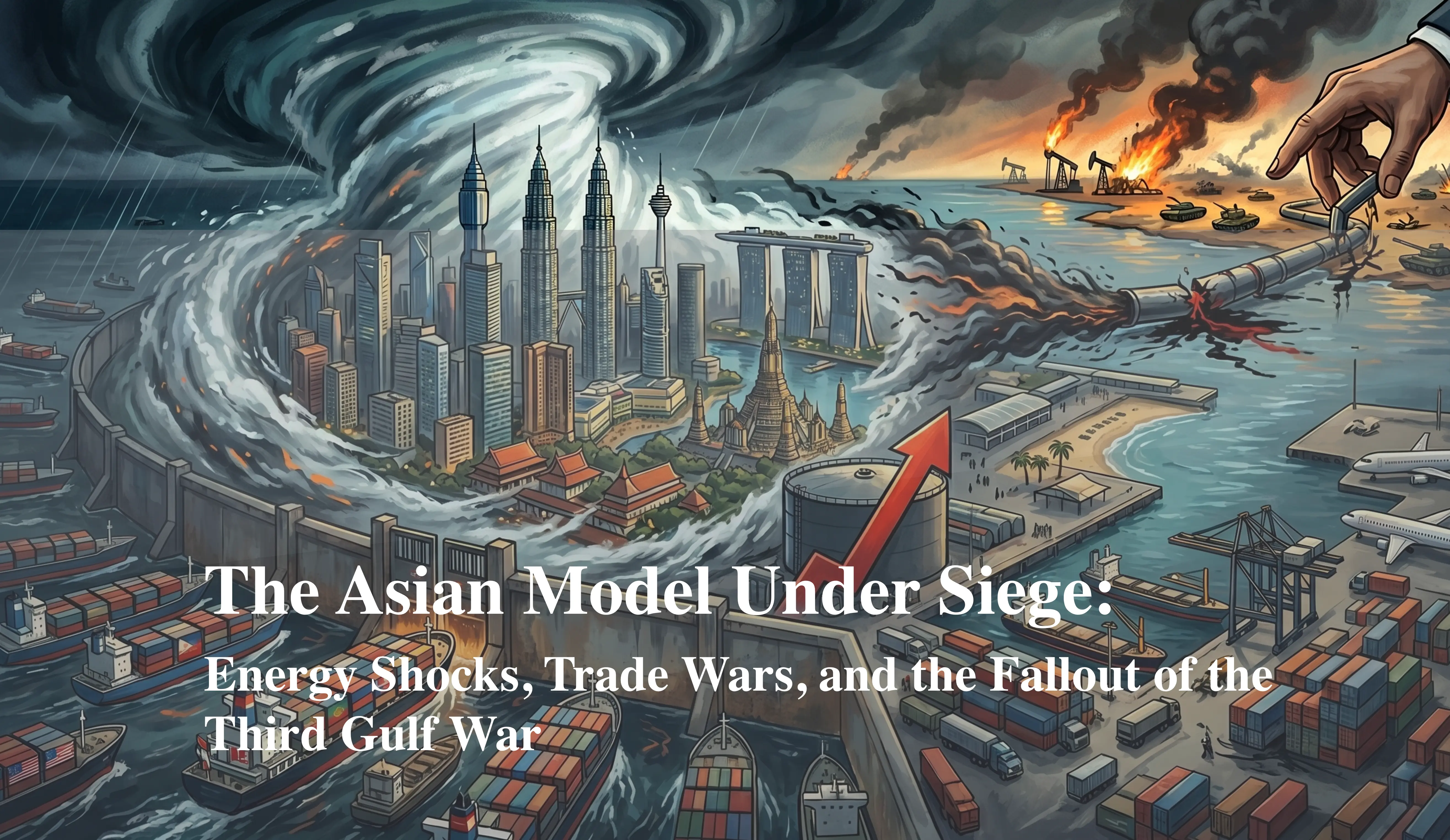
The economic foundations of Southeast Asia are facing an unprecedented stress test. The lack of reliable energy resources, the sudden imposition of aggressive tariff barriers, and the severe blocking of global supply chains are coalescing into a perfect storm. This convergence threatens to slash exports, drastically inflate national economies, and destabilize the very geopolitical order that has allowed the region to thrive for half a century.
Here is a question for you. Name the economies where exports account for more than half of GDP. Germany? No — 41%. China? No — 20%. The answers are Vietnam (90%), Cambodia and Malaysia (70%), Thailand (60%), and Singapore, which, at 175%, exports more than it produces, the economic equivalent of a magic trick. These are not merely export-oriented economies. They are the beating heart of globalization. Strip away the flows of goods, capital, and technology of the last five decades, and you strip away the Asian model itself.
The Dual Threat: War in the Middle East and Trade Coercion
The destructive consequences of the Middle East war, initiated by the United States and Israel against Iran through Operation Epic Fury, are now directly affecting the countries of the Asian region. The negative effects of this conflict, combined with the renewed "tariff wars" under the Trump administration, are hitting the export-oriented economies of Southeast Asia the hardest.
Trump's coercive trade policies have placed severe pressure on these nations. These tariffs are sudden, volatile, whimsical, and coercive. To avoid crippling economic damage, countries have been forced into a race to strike deals under duress, trading tariff exemptions for political and economic concessions. Combined with the threat of transhipment tariffs of 40%, designed to prevent rerouting, nations like Singapore, Vietnam, and Thailand are exposed to an operational and compliance nightmare.
The Energy Crisis and Rising Inflation
A prolonged period of soaring fuel prices threatens to drastically increase inflation across ASEAN economies, stunt Gross Domestic Product (GDP) growth, and elevate the risk of social unrest.
The impact of the energy crisis on Southeast Asia has been severe. While some Southeast Asian countries produce their own oil and gas and have diversified supply sources, the region is still heavily dependent on fossil fuels from the Middle East and, therefore, extremely vulnerable to supply chain disruptions. Most regional states only have between 30 and 100 days of oil reserves.
The immediate economic shockwaves are already visible. The outbreak of the war saw fuel prices surge across Southeast Asia. In the Philippines, Vietnam, Cambodia and Myanmar, diesel and petrol prices increased 50 per cent. The price of jet fuel, a product of crude oil, also doubled. Although some Southeast Asian airlines took advantage of flight disruptions in the Middle East, higher ticket prices have negatively impacted the region’s lucrative tourism industry. In March, tourist arrivals in Thailand were down 50 per cent on the previous month. By one estimate, if the conflict lasts longer than six months, up to three million fewer tourists will visit Thailand, resulting in an estimated US$4.5 billion in lost tourism revenue.
To prevent domestic unrest stemming from this inflation, governments are implementing desperate measures, such as Indonesia's pledge to continue fuel subsidies while introducing fuel rations for private motorists.
Geopolitical Destabilization and the Erosion of Norms
Beyond the economic fallout, the US is increasingly perceived as using this conflict to destabilize the region, prioritizing military coercion, unilateralism, and transactionalism over multilateral diplomacy. By aggressively transferring its policy of forceful intervention to the Asian region, the United States is prompting a recalculation of regional security alliances and risking a devastating arms race.
The diplomatic responses from Southeast Asian capitals reflect deep unease with this trajectory. Malaysia, Brunei and Timor-Leste condemned both the US-Israeli attacks and Iran’s retaliatory strikes. Malaysian Prime Minister Anwar Ibrahim, a trenchant critic of American and Israeli policies in the Middle East, “unreservedly” condemned the killing of Iran’s supreme leader, Ali Khameini, and accused Washington and Tel Aviv of pushing the Middle East to “the edge of grave and sustained instability”. Singapore, which has close relations with the US, Israel and the Gulf states, said it “regretted the failure of negotiations”. In subsequent remarks at a meeting of ASEAN foreign ministers, however, Foreign Minister Vivian Balakrishnan did condemn Iran’s attacks on the Gulf states.
In contrast to its fellow Muslim-majority neighbours, Indonesia stopped short of condemning the attacks and merely said it “deeply regretted” the failure of talks between the US and Iran. In line with President Prabowo’s aspirations for Indonesia to play a more proactive role in world affairs, he offered to mediate the dispute. However, none of the warring parties took his offer seriously and in subsequent statements, Prabowo acknowledged that other countries might be better placed to facilitate talks. In response to domestic criticism of US actions, Prabowo suspended Indonesia’s participation in US President Donald Trump’s Board of Peace for Gaza.
Looking Ahead
The Asian miracle was built on the fundamental assumption that the global system of open trade and geopolitical stability would hold. That system is now fracturing. Southeast Asia finds itself caught between a debilitating energy crisis sparked by military conflict and an aggressively coercive trade environment. To survive, regional governments must urgently determine how to improve their energy sovereignty, fortify supply chain resilience, and navigate a rapidly deteriorating rules-based international order.
Reference:
1.Southeast Asia and The Third Gulf War: fulcrum.sg
2. The Asian Trilemma : pushandutt.substack.com