
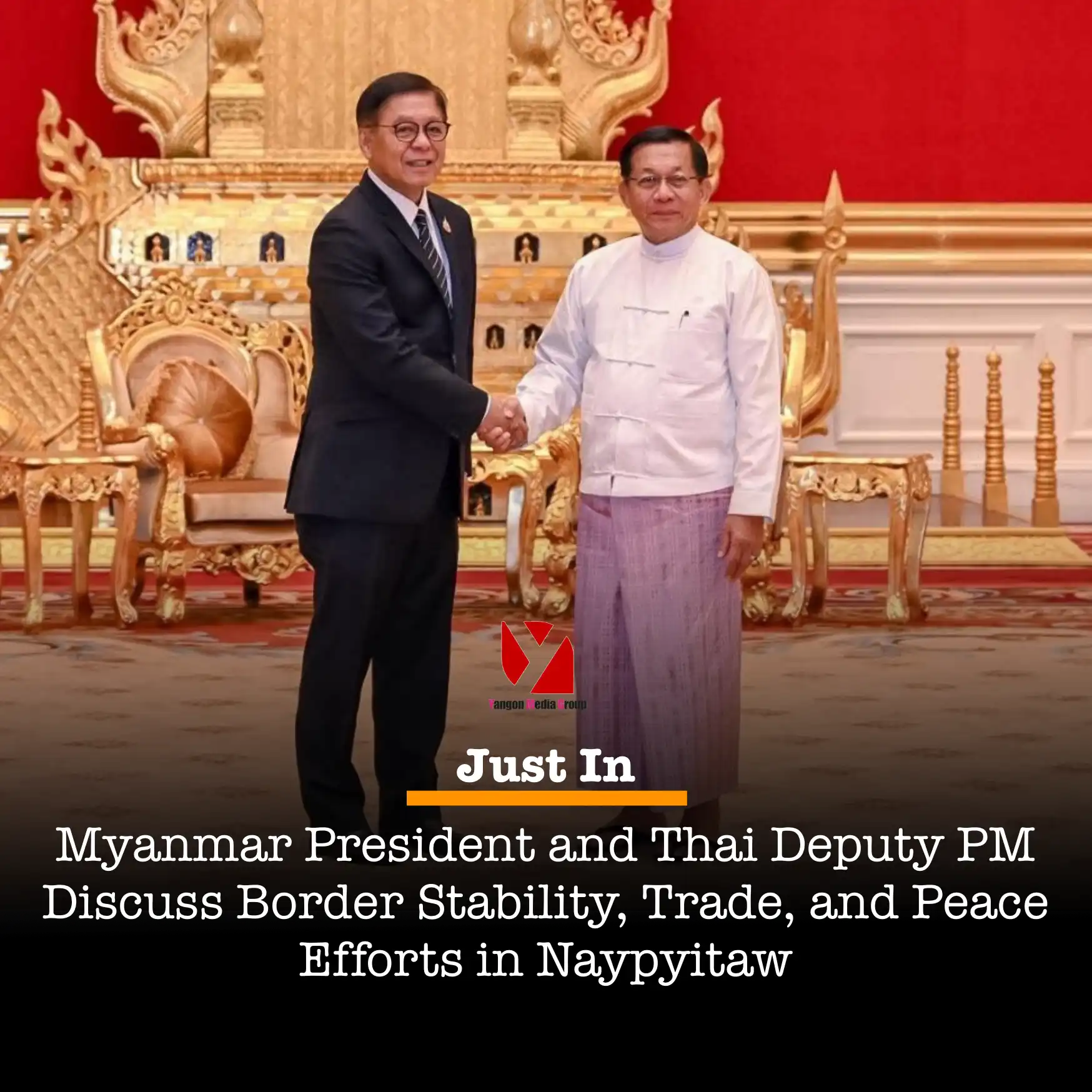
NAYPYITAW, April 22 — Myanmar President U Min Aung Hlaing and Thailand’s Deputy Prime Minister and Minister of Foreign Affairs, Mr. Sihasak Phuangketkaew, met in Naypyitaw this morning to discuss bolstering bilateral cooperation on border stability, trade promotion, and Myanmar's ongoing peace processes.
During the meeting held at the Presidential Guest House, the leaders addressed key border challenges facing the two neighboring countries. The discussions focused heavily on joint efforts to eradicate online scams and illegal gambling operations, combat illicit drug trafficking, and resolve the persistent issue of cross-border transboundary haze. Furthermore, both sides deliberated on reopening trade routes to enhance cross-border commerce and economic exchange.
On the political and peacebuilding fronts, the dialogue covered Myanmar's cooperation in providing humanitarian assistance in accordance with the ASEAN Five-Point Consensus. The Myanmar administration elaborated on its recent invitations for internal peace dialogues, while exploring potential avenues for Thailand to assist and participate in Myanmar's broader peace initiatives.
The high-level meeting aimed to further elevate the long-standing diplomatic relations and good neighborly cooperation between the two nations. As part of the contextual briefing, Myanmar officials informed the Thai delegation about the convening of multiparty democratic general elections and the government's stated commitment to continuing its path toward democracy.
The meeting was attended by a high-level Myanmar delegation, including Union Minister for the President's Office U Khin Maung Yi, Union Minister for Foreign Affairs U Tin Maung Swe, Union Minister for National Planning, Investment and Foreign Economic Relations U Aung Kyaw Hoe, and Union Minister for Electric Power and Energy U Ko Ko Lwin. The Thai delegation included advisors to the Foreign Minister, Mr. Kallayana Vipattipumiprates and Gen. Nothapol Boonngam, alongside officials from the Royal Thai Embassy in Myanmar.
Concluding the talks, both nations agreed to further solidify their diplomatic ties and mutual friendship. They committed to expanding multifaceted cooperation across various key sectors, including agriculture, livestock, investment, electricity and energy, and manufacturing.