
By K.R. Anand
16 April 2026
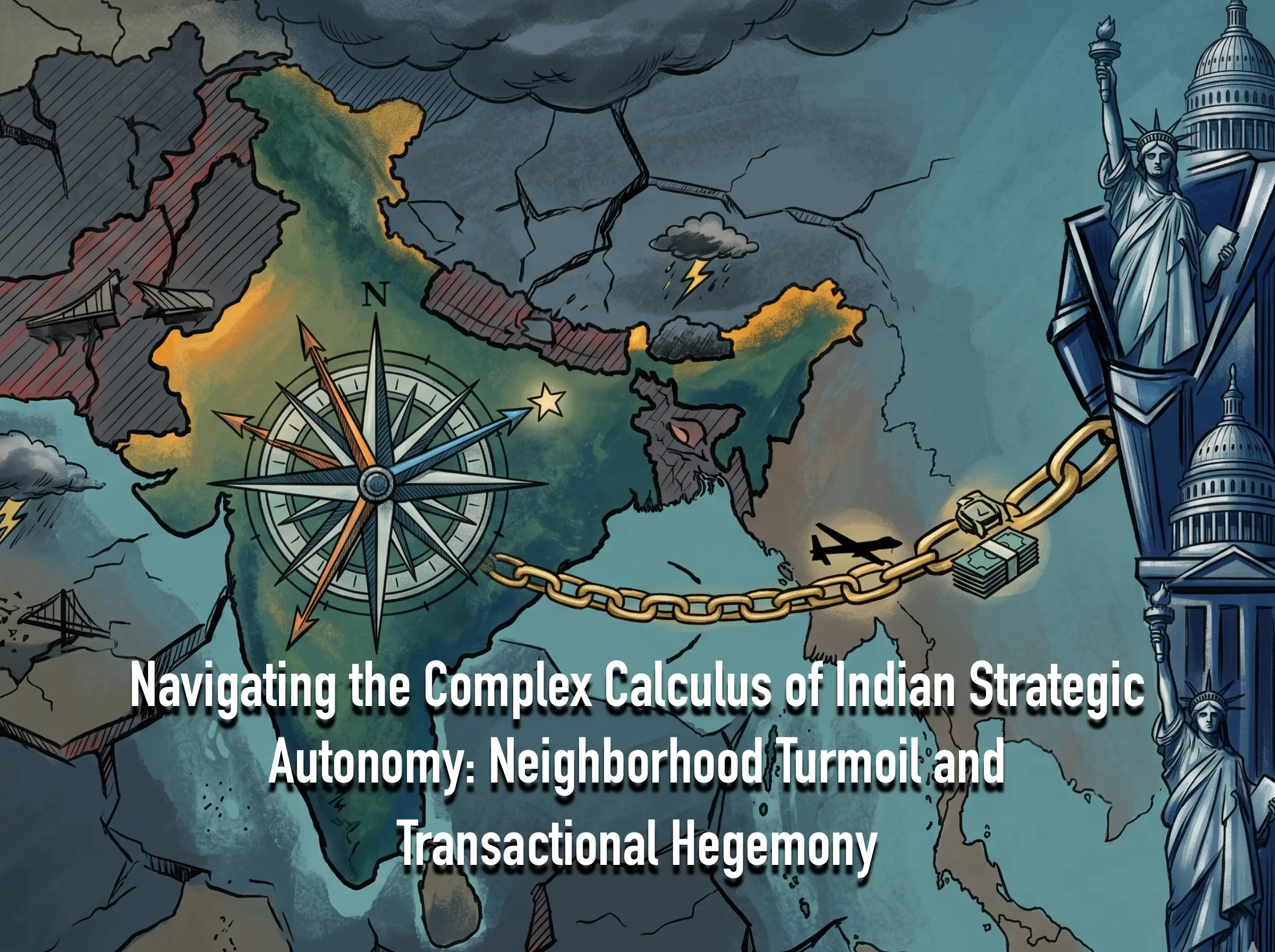
The contemporary geopolitical landscape presents India with a multifaceted diplomatic paradigm, characterized by a rapidly deteriorating regional consensus in South Asia and an increasingly transactional strategic partnership with the United States. As New Delhi endeavors to project its influence and secure its economic trajectory, it must simultaneously manage the collapse of favorable political structures in its immediate neighborhood and navigate the rigid, conditional frameworks imposed by its Western allies. This precarious environment necessitates a profound recalibration of India’s foreign policy, demanding a pivot toward alternative regional partnerships to secure its long-term strategic depth.
The Disintegration of the Neighborhood Consensus
Historically, India has relied on a stable and cooperative bilateral framework with Bangladesh, anchored by the long-standing administration of Prime Minister Sheikh Hasina. However, the political architecture of Dhaka has fundamentally transformed. In the eighteen months following Hasina's ouster and subsequent flight to India, the strong diplomatic ties between New Delhi and Dhaka have rapidly unraveled, deteriorating from bad to worse. The vacuum left by the ban on Hasina’s Awami League has deprived New Delhi of a reliable, pro-India political force, paving the way for a resurgence of simmering, and often violent, anti-India sentiment. This hostility has most tangibly manifested in an alarming rise in violence directed against minority communities, particularly Hindus.
Complicating the regional security matrix is the evolving diplomatic posture of the United States toward Islamist factions within Bangladesh. Washington has actively expanded its diplomatic engagement with Jamaat-e-Islami, a political entity with a documented history of anti-India ideology and fierce opposition to Bangladesh’s 1971 war of liberation. Demonstrating a striking pivot, US embassy officials recently met with Jamaat leaders in Sylhet, with diplomats reportedly expressing a desire for the United States to be "friends" with the organization. This outreach—coupled with the granting of a US visa to Jamaat chief Shafiqur Rahman despite his history of extremist rhetoric—signals a concerning willingness by Washington to engage with forces that pose a clear and present security concern for India.
Looking ahead to Bangladesh's elections, the dominant political factions—the Bangladesh Nationalist Party (BNP), Jamaat-e-Islami (JI), and the newly formed National Citizen Party (NCP)—all present distinct challenges to Indian interests. While a BNP victory might yield a pragmatic but cooler relationship driven by "sovereignty-first" rhetoric, a Jamaat-e-Islami victory threatens to push Bangladesh toward strategic diversification, potentially aligning Dhaka closer to China or Pakistan for defense and infrastructure cooperation. Furthermore, relations with the youth-led NCP, birthed from the 2024 student protests, remain highly contentious, exacerbated by mutual visa suspensions and Dhaka's demands for the extradition of Sheikh Hasina.
The Conditional Hegemon: 'America First' and the New Bilateral Reality
Concurrent to the unraveling of its neighborhood stability, India is facing a stringent redefinition of its macro-level strategic partnership with the United States. At the recent Raisina Dialogue in New Delhi, US Deputy Secretary of State Christopher Landau articulated a remarkably candid vision of Washington's foreign policy framework under the "America First" doctrine. Landau emphasized that American diplomatic engagement is driven strictly by national interest, explicitly stating that Washington is not in the business of "social work".
Crucially, the United States has drawn a rigid line regarding economic integration, driven by an acute awareness of its past diplomatic miscalculations. Landau delivered a blunt warning that the US will not replicate the "historic error" it made with China two decades ago, referencing the era when Washington granted Beijing open-ended market access and World Trade Organization entry without sufficient conditions. Washington views that sequence of decisions as an economic roadmap that allowed China to transform into a formidable commercial and strategic rival. Consequently, while Washington views India as a nation with "almost unlimited potential" and an essential strategic counterbalance in the Indo-Pacific, any deepening of the US-India economic partnership will be strictly conditional, demanding absolute reciprocity and mutual respect.
While the US-India Free Trade Agreement reportedly nears completion, and Washington has offered temporary concessions—such as a 30-day waiver on sanctions related to Indian purchases of Russian oil—the overarching message is unmistakable: India will not be afforded the unhindered developmental ride previously given to China. This approach has drawn sharp criticism from various geopolitical observers, with former Maldivian President Mohamed Nasheed expressing shock at the implication that the US might artificially constrain India's economic prosperity.
In response to this conditional paradigm, Indian diplomacy has vigorously reasserted its sovereign agency. Foreign Minister S. Jaishankar eloquently pushed back against the American narrative, declaring that the ascent of a nation is ultimately determined by its own inherent strength and capabilities, rather than capitalizing on the diplomatic mistakes of others. Jaishankar framed India’s developmental and strategic trajectory as fundamentally "unstoppable," signaling that New Delhi will dictate the terms of its own rise.
Conclusion: The Eastern Imperative and the Myanmar Catalyst
As the traditional pillars of India's neighborhood policy fracture in Dhaka and its primary Western partner enforces strict, transactional guardrails, New Delhi’s path forward requires cultivating new avenues of strategic depth. In this context, Myanmar presents a vital, yet underexploited, opportunity for strategic and economic expansion. By enhancing cross-border connectivity, deepening bilateral trade, and fostering a robust strategic partnership with Naypyidaw, India can secure a critical eastern flank.
Crucially, engaging with Myanmar allows India to advance its regional interests while conscientiously avoiding direct entanglement in the broader US-China geopolitical rivalry. Effective cooperation between New Delhi and Naypyidaw serves not only to stabilize a historically volatile border region but also acts as a vital geopolitical bridge, allowing India to strengthen and deepen its institutional and economic connections with the broader ASEAN bloc. In an era defined by neighborhood hostility and great-power transactionalism, prioritizing the eastern gateway through Myanmar is an indispensable strategy for ensuring India's unstoppable ascent.
Reference:
1.Bangladesh crisis:Is US backing Islamists ahead of crucial polls : timesofindia.com
2. Washington Draws a Line: The US will not Give India the Ride it Gave China: asiamediacenter.org
3. How India Lost bangladesh: thediplomat.com