
"This article was originally published in MNTT and is republished here with the permission of the author."
By- Kaung Myat Kyaw
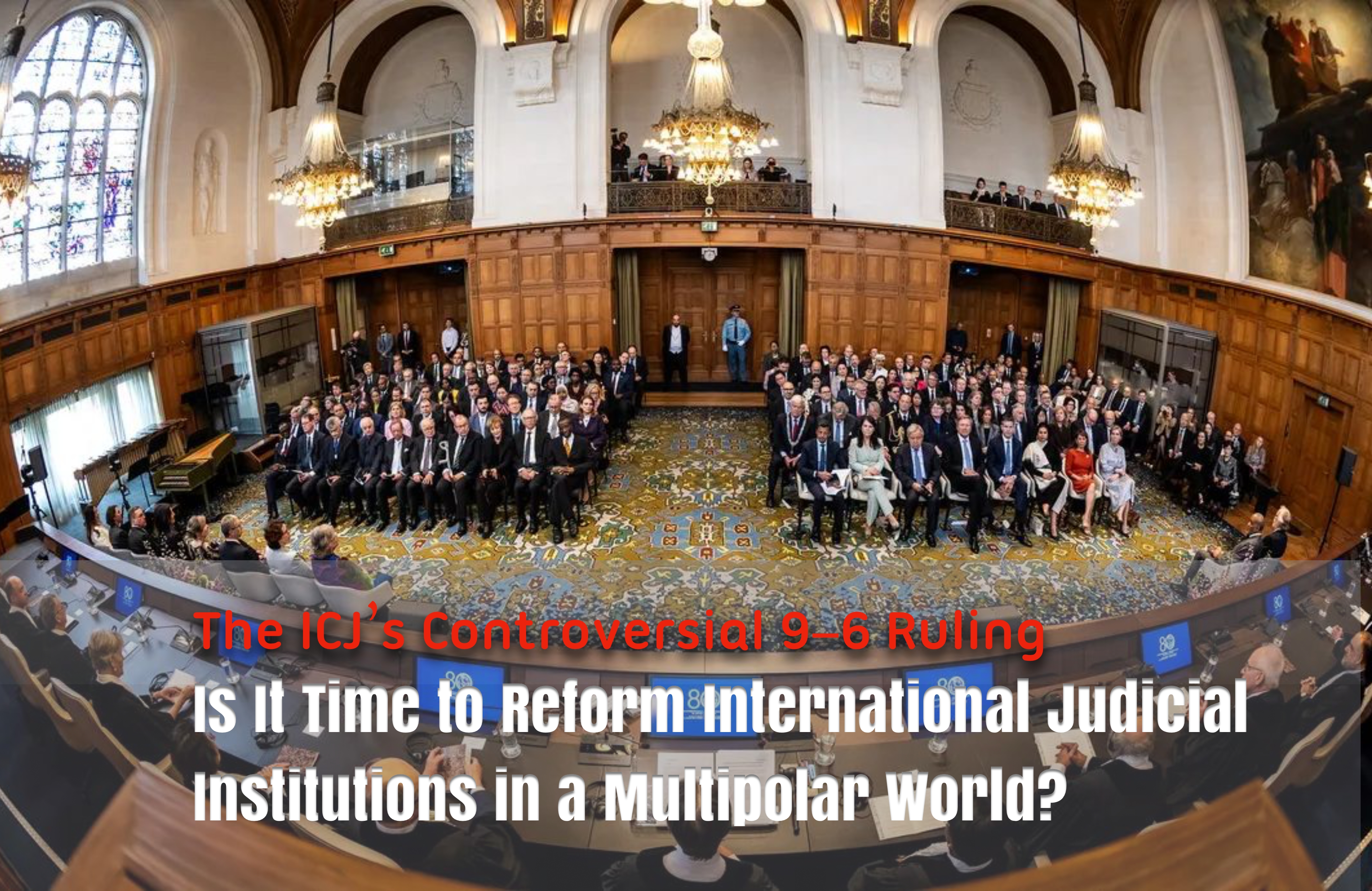
November 19, 2026, will go down in the history of international justice as a notably controversial day. Led by Japanese Judge Yuji Iwasawa, the International Court of Justice (ICJ) delivered its final judgment in the case brought by The Gambia on behalf of the Organisation of Islamic Cooperation (OIC), ruling that Myanmar violated the 1948 Convention on the Prevention and Punishment of the Crime of Genocide (Genocide Convention).
Although this is the first judgment in the history of international justice to formally rule that a sovereign state committed genocide, the fact that it was decided by an exceptionally narrow margin of 9–6 among the 15 judges has raised major questions regarding the legal rigor and impartiality of the verdict. For the citizens of Myanmar, this decision appears less as a delivery of justice and more as an injustice in which international legal standards were stretched at will.
The Firm Legal Dissent of Six Judges
The six judges who rejected the nine-judge majority decision and voted against it—ICJ Vice-President Julia Sebutinde, along with Judges Peter Tomka (Slovakia), Ronny Abraham (France), Xue Hanqin (China), Georg Nolte (Germany), and Judge ad hoc Claus Kress—issued a 26-page Joint Dissenting Opinion explicitly pointing out that the majority’s ruling deviated from the established legal framework.
Without suggesting that the actions of Myanmar’s security forces were blameless, their dissent firmly refuted, on four legal grounds, that the case met the highest international criminal standard of "genocide":
1. Failure to Adhere to the "Only Reasonable Inference" Standard — Under the standard established and applied by the ICJ itself in Bosnia v. Serbia (2007) and Croatia v. Serbia (2015), inferring genocidal special intent (dolus specialis) from circumstantial evidence requires that there be no other reasonable inference. However, because Myanmar’s operations in response to attacks by ARSA could also be reasonably inferred as intended for the forced displacement of Bengalis (referred to by the Court as Rohingya), or for collective punishment, intimidation, and deterrence to prevent future support for ARSA, the six judges pointed out that genocidal special intent had not been proven.
2. Blurring the Legal Distinction Between Genocide and Forcible Displacement — Under international law, there is a clear legal distinction between the intent to physically or biologically destroy a group in whole or in part (genocide) and forcible displacement from a territory (forcible displacement). The dissenting judges objected that the nine-judge majority’s decision blurred this distinction and effectively broadened the definition of genocide established in previous ICJ jurisprudence.
3. Lowering the Standard of Proof — The six judges objected that the majority decision lowered the strict evidentiary standard required to prove genocidal intent. In particular, they pointed out that the majority placed excessive weight on the reports of the UN Fact-Finding Mission as evidence, and that the assertion of a uniform pattern of conduct across 54 villages lacked sufficient detailed supporting evidence. Furthermore, they criticized that the majority’s method of interpreting the evidence significantly weakened the standard of proof set forth in the ICJ’s prior case law.
4. The Need to Strictly Adhere to the Legal Framework Under the Genocide Convention — Under Article IX of the 1948 Genocide Convention, the ICJ’s jurisdiction in this case is strictly confined to disputes relating to that Convention. Although war crimes or crimes against humanity may have occurred, they are legally distinct from genocide. Therefore, the six judges dissented that if genocidal special intent cannot be proven to the required evidentiary standard, the Court should not find that Myanmar committed genocide.
Blatant Double Standards and Political Pressure
The most glaring and least acceptable aspect of this judgment is the double standard in international justice. Even in the Bosnia and Croatia cases, where hundreds of thousands of lives were lost amid massive atrocities, the ICJ upheld a strict legal standard and declined to rule that Serbia committed genocide. Yet, when it came to Myanmar’s turn, lowering that long-maintained standard to issue the first-ever genocide ruling makes it evident that political targeting, rather than strict adherence to the law, was involved.
Legal observers critically analyze that under a lawsuit backed by the 57 member states of the OIC and years of systematic lobbying and pressure from international NGOs (including George Soros’s Open Society Foundations), the nine-judge majority prioritized humanitarian sentiment and international image over legal discipline.
Moreover, an undeniable reality on the ground is that hundreds of thousands of Bengalis (referred to by the Court as Rohingya Muslims) continue to live and make a living inside Myanmar to this day. The Court’s disregard for this vast gap between the reality on the ground and the allegation of an "intent to completely exterminate an entire ethnic group" further deepens doubts about the fairness of the ruling.
Subsequent Orders and Future Outlook
The measures ordered by the Court for Myanmar to comply with are as follows:
- Return destroyed or lost property and pay reparations and compensation.
- Allow displaced persons to return safely to their original homes.
- Investigate and hold perpetrators accountable, and provide guarantees of non-repetition.
- Submit a report detailing the above compensation and rehabilitation measures to the ICJ within two years (the deadline is November 19, 2028).
Myanmar has criticized and rejected this judgment as unfair. Although failure to comply within the stipulated period carries the possibility of referral to the United Nations Security Council under Article 94(2) of the UN Charter, the existence of veto power in the Security Council means that international political obstacles will continue to impede practical enforcement.
The New Multipolar World Order, the ICC Crisis, and International Judicial Reform
The 9–6 ruling against Myanmar extends beyond the affairs of a single nation, starkly highlighting the need to reform international judicial institutions to align with the evolving new multipolar world order. It is time to reform institutions like the ICJ—built upon the post–World War II political architecture of 1945—by updating their structures and foundational principles and incorporating checks and balances capable of curbing judicial overreach and biased decisions.
This crisis of credibility is not confined to the ICJ; The Hague’s other international court, the International Criminal Court (ICC), is also facing fierce criticism and retaliatory measures from major global powers over accusations of jurisdictional overreach and political instrumentalization:
- Fierce Criticism and Sanctions from the United States — The United States, which is not a party to the Rome Statute, has long criticized the ICC for overextending its jurisdiction over citizens of non-member states and its allies. Starting in 2025, after sanctioning 17 individuals including ICC judges and prosecutors, the U.S. government on October 9, 2026, imposed unprecedented sanctions on the ICC as an entire institution, exerting pressure aimed at systematically halting the Court’s operations. U.S. President Donald Trump also sharply criticized the ICC as being "out of control" and excessively expanding its jurisdiction.
- Russia’s Rejection and Retaliatory Measures — Russia, also not a party to the Rome Statute, flatly rejected the 2023 ICC arrest warrant against President Vladimir Putin as a legally void political fabrication. Furthermore, Russia issued retaliatory arrest warrants against nine judges and prosecutors, including members of the ICC presidency, and in October 2026 made formal requests to the Netherlands and other countries for their extradition.
- Joint Warning by Major Powers — On the very same day the ICJ delivered its ruling against Myanmar—November 19, 2026—at a sideline meeting of the APEC Summit in Shenzhen, China, U.S. President Donald Trump, Russian President Vladimir Putin, and Chinese President Xi Jinping jointly issued the Declaration Toward Peace, explicitly warning The Hague-based court and other international institutions "not to abuse their jurisdiction."
|
CONCLUSION Viewed as a whole, international justice must no longer serve as a political weapon that bends the law at will for the powerful and those capable of exerting organized group pressure. At a time when major global powers such as the United States, Russia, and China themselves are fiercely criticizing and opposing the abuse of jurisdiction by the ICC and Hague-based judicial institutions, the ICJ’s 9–6 ruling against Myanmar—delivered by lowering legal standards and overriding the firm legal objections of six judges—stands as the clearest proof of the flaws in the current international judicial system. Consequently, this ruling has sounded a historic wake-up call that in the new multipolar world order, systematic reform of institutions like the ICJ and ICC—covering their structure, uniformity of legal standards, and mechanisms to check bias and judicial overreach—is an imperative whose time has come. |
Kaung Myat Kyaw is an independent international affairs analyst and researcher. The views expressed in this article are his own.
News and Official Sources Cited
1. UN News: ICJ rules Myanmar responsible for genocide against Rohingya (November 19, 2026)
2. Courthouse News Service: Joint Dissenting Opinion of Judges Sebutinde, Tomka, Abraham, Xue, Nolte and Judge ad hoc Kreß in The Gambia v. Myanmar
3. International Court of Justice (ICJ): Statute of the International Court of Justice (Articles 18, 20, and 60); Bosnia and Herzegovina v. Serbia and Montenegro (2007); Croatia v. Serbia (2015)
4. United Nations: Convention on the Prevention and Punishment of the Crime of Genocide (1948) & Charter of the United Nations (Article 94)
5. International Criminal Court (ICC) & IISS: The ICC strongly rejects US sanctions against the institution (October 9, 2026) & The ICC under further threat from the United States (November 13, 2026)
6. The Guardian & A News: Global courts under attack and takeaways from the Trump, Xi, Putin Shenzhen summit & Declaration Toward Peace (November 19–20, 2026)
7. Opinio Juris & OHCHR: Russia's retaliatory arrest warrants and 2026 extradition requests against ICC judges and prosecutors (February & November 2026)
8. MOFA Myanmar: Press Statement by the Ministry of Foreign Affairs of the Republic of the Union of Myanmar on the Judgment of the International Court of Justice delivered on 19 November 2026 (November 20, 2026).